


KALAMBOOR on BPL #147, Restreams and PUBG Mobile in EECA
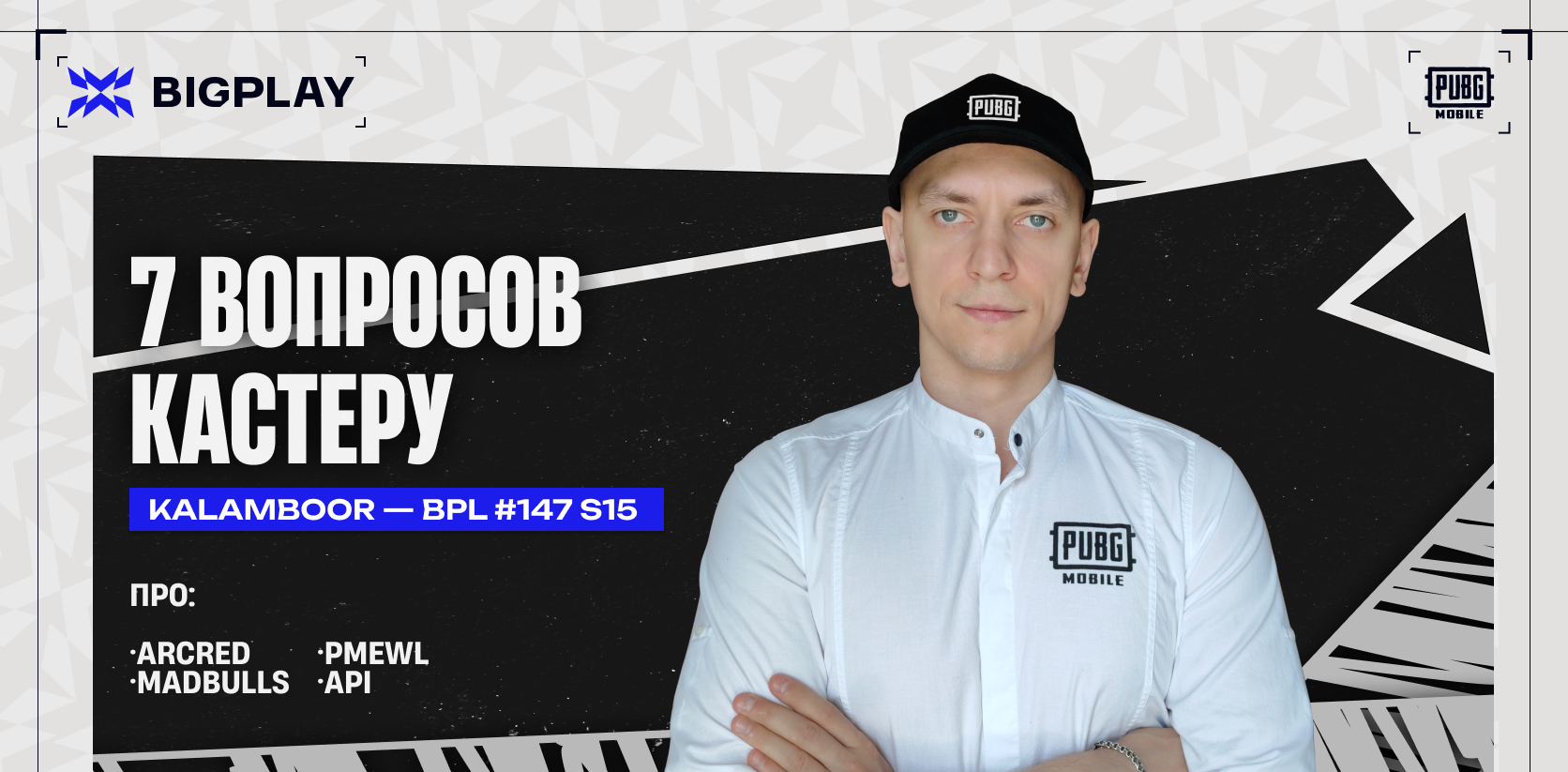
Where did the zone help ARCRED, why did GOAT keep pushing, and what did PMCS lack? KALAMBOOR breaks down the BPL #147 final and explains why he prefers his own broadcasts and builds community tools himself.
ARCRED won BigPlay Pro League #147 S15 in PUBG Mobile, finishing the final with 77 points and two WWCDs. Behind the standings were decisions that could have changed the tournament: GOAT’s attack on their direct rival, PMCS’s recovery from a poor start, and TUNA winning the final Miramar after starting with three players.
Caster KALAMBOOR breaks down the key moments of the final and the performances of five teams. In the second part of our interview, we discuss the women’s PMEWL series, the freedom of his own restreams, player rankings for EECA, API development and the projects he invests his time in.
The BPL #147 Final: ARCRED, GOAT, PMCS, MadBulls and TUNA
1. ARCRED won both Erangel games and finished the BPL #147 final with 77 points. What about those two performances best explains their title? Where did they create their own advantage, and where did zone shifts help them?
I would separate those two wins, because luck did help ARCRED to some extent on the first Erangel, while on the second they made the most of their opportunities through very smart play.
The first Erangel was the opening map of the final. As we know, teams usually play the early matches with maximum discipline: they take fewer risks, rotate more cautiously and try to avoid unnecessary fights.
ARCRED did have some luck here. The zone shifted towards the “Kukushka” position near Yasnaya Polyana, and they rotated there fairly quickly. The following shifts also stayed around their positions. Only in phase five did the zone start moving away from them. From that point, ARCRED played the edge, methodically clearing space and collecting kills.
In the closing stages, we saw a full 4v4 teamfight against APML. In my opinion, APML did not have much of a chance, considering the level and experience of their opponents. Still, special respect to APML for trying to wrap around and force ARCRED out of their position. It was an interesting call, but they could not execute it against such an experienced roster.
The second Erangel was a completely different situation. As a tournament approaches its end, matches become more dynamic: teams take more risks, make decisions faster and commit noticeably more mistakes.
By then, ARCRED had built a healthy points cushion through their strong start, so they could afford to play more patiently, without unnecessary or rushed moves.
In the early phases they held positions closer to the centre, but as they saw how quickly the number of surviving teams was falling, they adjusted their game in time. Rather than continuing to hold potentially dangerous central positions, they moved into the northern part of the safe zone, where they gathered information intelligently and controlled what was happening around them.
By the closing stages, ARCRED had a fairly clear picture of the situation on the map. They began creating extra attacking angles, pinching teams that were down players and gradually converting their advantage.
But I would particularly highlight HardBoy’s individual execution in the very late game. He did not rush. He waited for the right moment and eliminated LEMON with an accurate burst along the edge of the smoke in first-person view. To me, that was one of the key moments of the endgame. Then he used his experience to win another decisive duel.
To sum up, zone shifts really did help ARCRED on the first Erangel, but on the second they largely created the win through their own decisions. They avoided unnecessary fights, chose the right positions, gathered information and, most importantly, kept their numbers up into the very late game. At the decisive moment, high individual skill completed the picture.
There is another point I would like to make. From what I have seen, the foundations of a title at tournaments like this are very often laid in the first two matches. A good start gives a team not just a points advantage but also a degree of freedom in its later decisions. You can keep a cool head rather than trying to recover lost ground at any cost.
In my view, that is exactly what ARCRED took advantage of. They built a comfortable cushion at the start of the final, then managed the rest of the tournament well enough to turn it into a title.
2. On the final Miramar, GOAT’s run ended in a direct fight with ARCRED at the rocks. Could they have executed that attack better, or did ARCRED’s positional advantage already decide too much? What was the key moment of the fight for you?
For me, this was actually one of the most interesting clashes of the entire final. It is not just about the fight itself, but also about the decisions leading up to it.
Both teams had built a significant gap over the rest of the field. Despite ARCRED’s two WWCDs, GOAT were still in the title race. That is hardly surprising: GOAT are known for their consistency and ability to adapt quickly during a tournament. They understand how the situation on the map is developing, when to speed things up, which positions to take and at what stages to avoid unnecessary fights.
But that is exactly why my main question is: how quickly did GOAT realise that the team in front of them was ARCRED? And did they realise it at all?
Why am I focusing on this? Because ARCRED were not really the ones initiating the fight. They already held a favourable high-ground position and were mostly defending, trying to hold GOAT off while creating extra defensive angles. GOAT, meanwhile, kept pushing forward and forcing the fight.
To me, that is where the most interesting issue lies. Why did GOAT not decide to disengage? They still had room to manoeuvre. They could have tried moving around to the west or east, taken another position and continued their game. With all four players alive, they might even have been able to fight for the centre of the zone.
Instead, they kept putting pressure specifically on ARCRED.
That is why I suspect GOAT may have identified their direct title rival and consciously chosen to take the risk. Perhaps the logic was that eliminating ARCRED right there would substantially improve their chances of winning the title. If it failed, then the gamble simply had not paid off.
Could they have played the attack better? Absolutely. In fact, they could have avoided making it altogether. ARCRED’s positional advantage certainly mattered, but I would not say GOAT had no alternatives.
For me, the key moment was not even a particular exchange. It was GOAT’s decision to keep attacking despite an unfavourable position and the other options available to them.
That is why I lean towards the idea that this went deeper than a simple positioning mistake. I would not rule out GOAT deliberately going all-in to eliminate their main title rival. If that was indeed the case, we saw more than a fight between the final’s two strongest teams: it was an attempt to decide the entire tournament in one clash.
3. PMCS recovered after finishing last on the opening map, and YANKI secured a solo win on Rondo. What helped them improve so much during the final? What did they lack on the last two maps to keep fighting for the title?
At BPL #147, PMCS were the team that impressed me the most. Above all, I was not expecting such a confident performance from them, especially after a disastrous opening match.
But when you look at their entire final, one phrase comes to mind: a classic. Let me explain why.
On the second map, Miramar, they won the drop contest against MoneyMakers, who were challenging for their spot, although they lost a teammate in the fight. Things then worked out quite favourably for PMCS: the zone repeatedly shifted around Power Grid, effectively their home territory. That allowed them to minimise rotations, focus on controlling space and still have a strong impact. They collected a lot of points, laying the foundations for their return to the title race.
Of course, the third map, Rondo, made an even bigger difference. YANKI produced an incredible endgame and secured the WWCD on his own.
After that, I think PMCS really began to believe in themselves. The second match brought a good points haul, the third ended in a win, and suddenly they could almost taste the title. That always affects a roster’s mentality: players act more confidently, make more measured decisions and try to keep mistakes to a minimum.
So why did I call it a classic at the start?
Because on the last map, while PMCS still had a real chance of becoming champions, they lost the very same contest against MoneyMakers that they had won earlier.
That brings us back to one of PUBG Mobile’s characteristics: every drop contest contains some randomness. You can win a fight today and give yourself excellent conditions for the rest of the game, then lose the same fight in the next match and effectively lose your title chances.
To me, that reveals a certain contradiction in PMCS. On one hand, they can adapt; on the other, some of their decisions remain fairly rigid.
For example, recently on Erangel they have been prepared to give up their usual spots and avoid contests in favour of a more stable, pragmatic start. On Miramar, it is a completely different story. Perhaps principles or even competitive pride came into play: we have already conceded enough positions on Erangel, but we are not giving up our spot on Miramar.
On one hand, that stance is understandable. A team wants to defend its territory and not give way to direct competitors. On the other, we can clearly see how costly that decision can be at the decisive moment of a final.
So, when asked what PMCS lacked to win the title, I would point to flexibility in strategic decision-making. They have already proved they can deliver results, collect points and win even the toughest endgames. But when you are directly fighting for first place, sometimes avoiding a fight over principle matters more than proving your superiority at any cost.
Essentially, on the last Miramar they just needed to avoid a risky drop contest and preserve the chance to play out a full game. Of course, that would not have guaranteed the title, but it would have kept them in the fight.
That, in my opinion, is what PMCS were missing. They recovered from a poor start, but at the most important moment they did not show the flexibility that might have carried them to the title.
4. At BPL #146, MadBulls won the last two maps. At BPL #147, they finished sixth without a WWCD. TKM stopped them on Rondo, and even 13 kills on the second Erangel did not produce a win. How do you compare those two finals for the Bulls? Where did opponents read them better, and where did they fall short themselves?
I think MadBulls are going through a fairly difficult period. After PUSHER’s departure, the team lost some of its previous consistency, and results became less predictable. That is fairly normal when a roster’s established synergy is disrupted.
I would not say the structure of their game has changed dramatically. The issue is more about the distribution of roles and the way the players work together. When you play with a new teammate at almost every tournament, you constantly have to adapt, rebuild communication and find the best ways to coordinate. You cannot always rely on a new player in the same way as someone you have played dozens or hundreds of matches with. That can lead to a certain lack of focus.
The interesting thing is that MadBulls have repeatedly proved they can compete even in those conditions. We have seen them secure top finishes with three or even two players left and still manage to become champions. Their individual skill and the roster’s potential have not disappeared.
When comparing BPL #146 and #147, the first thing I would discuss is the inconsistency in their recent results.
They won the last two maps of the #146 final, then went without a single WWCD at #147. But you cannot say MadBulls showed nothing. There were strong moments, productive fights and that second Erangel with 13 kills. That is a pretty good sign that they can still challenge almost any opponent.
But playing individual fights well is one thing; converting those successes into a map win is another. TKM stopped them on Rondo, while on Erangel even a high kill count was not enough to turn the match into a WWCD.
I would not state outright that opponents have become better at reading MadBulls. Perhaps it is less about what their rivals are doing and more about the Bulls themselves not always being able to maintain the same high level of concentration throughout a final.
I would not rule out a psychological factor either. Sometimes a team really does arrive at a tournament in less than ideal shape. They fight, score points and produce good moments, yet that title-winning drive does not quite seem to be there.
That is completely normal in competitive esports. We regularly see the same rosters dominate two or three tournaments in a row, then go several finals without their usual results. Staying at your peak all the time is almost impossible.
So I would not view MadBulls’ sixth place as a major decline or a loss of competitiveness. It looks more like temporary inconsistency, which may partly be linked to the constant roster changes.
I think once they settle on a permanent fourth player, restore their usual role distribution and build proper synergy, we will see the familiar MadBulls again: a team capable of consistently challenging for titles, rather than just collecting a lot of kills.
5. TUNA won the final Miramar after starting the map with three players. While ARCRED and TKM traded, TUNA preserved the option to choose when to join the fight. What did they do particularly well in that endgame, and why could they not be as effective throughout the final?
For TUNA Esports, the Miramar win was essentially their only truly standout moment at this tournament. The particularly interesting part is that they started the match with three players rather than a full squad.
I certainly do not want to diminish their win or the players’ efforts, but I think a favourable combination of circumstances also played a part.
First, by the final map TUNA were effectively out of the title race, so they could afford to play much more freely. When a team is not carrying the weight of having to finish first overall, it has more freedom in its decisions. You can be bolder, cause problems for opponents and worry less about every potential mistake.
Second, they kept all three players alive almost until the end. That was probably one of the key factors in their win. While other teams fought and the number of players alive dropped rapidly, TUNA avoided critical losses and retained their fighting strength.
Ultimately, while ARCRED and TKM were busy fighting each other, TUNA could choose the best moment to join in. Credit has to go to the players here: they used the situation intelligently and converted it into a WWCD.
But why could they not deliver the same results throughout the final?
I think the main reason is that this is a relatively new roster, even though the players themselves are far from new to competitive esports.
Leon and BadBoy previously played for OZAROX ESPORTS and have professional experience. But after major reshuffles, the lineup changed, with Capozinjo and Zero joining from other teams.
That brings us back to team synergy. You can bring together four strong players, but that does not mean they instantly become a complete team. They need time to build their own structure, distribute roles, establish communication and learn to understand each other in unusual situations.
In my view, that is what TUNA currently lack. They can produce individual standout matches, but they have not yet shown the consistency needed for a sustained title challenge.
The fact that they started the last map with three players also leaves questions. We do not know all the internal circumstances, so I would not draw any firm conclusions about why their fourth player was absent.
For me, TUNA’s Miramar win is therefore more a demonstration of individual potential than evidence of an established team system. They made excellent use of the circumstances, kept three players alive into the decisive stage and chose their moment to join the final fight well.
But to make results like that more than isolated moments, they still need to do a lot of work on synergy and their own structure. For now, there really are more questions than answers about this roster, although the players clearly have potential.
6. You often restream official PUBG Mobile tournaments, while working as an official caster for the women’s PMEWL series. Why do you choose your own broadcast in other cases? What matters most in that choice, and what makes PMEWL special enough to be the exception?
The women’s PMEWL series is something of an outlet for me. Why? Because these events do not happen very often, perhaps once or twice a year, and that gives me the chance to immerse myself much more deeply in the women’s competitive scene and follow its development from the early seasons to today.
I genuinely enjoy watching the women progress, rosters change and individual players develop professionally. There are constant reshuffles, teams change and new combinations of players emerge. Unfortunately, there are fewer new faces now. It is mostly familiar members of the old guard, and even some of them are gradually ending their esports careers.
That is why, for me, PMEWL is not just another tournament to cast. It is a story I genuinely want to follow.
I have never wanted to commentate on absolutely every official tournament. It is much more important to work on something that genuinely interests me, where I can learn something new, study teams and players, and share that knowledge with viewers.
So why do I usually choose my own restreams over official broadcasts in other cases?
It is actually quite simple. I love esports. I enjoy not only watching matches but also understanding what is happening and exploring the histories of teams and individual players.
But official casting comes with certain boundaries and restrictions. You have to follow the broadcast format and keep up with the pace of the game. You cannot always take the time to talk in detail about a team, recall a player’s past achievements or explore interesting moments from the history of the competitive scene.
On my own restream, I have much more freedom. I can tell viewers where a team came from, who a player used to play for, which titles they won and what made them memorable on the professional scene. I enjoy doing more than describing what is on screen: I want to give the audience extra information they might not hear anywhere else.
Another very important factor for me is direct interaction with viewers.
My regular broadcasts almost always have a delay. At the same time, a fairly large audience gathers every day, with dozens or even hundreds of questions appearing in chat. Naturally, answering all of them with a delay is extremely awkward.
When I get the chance to run a restream without delay, which I do fairly rarely, it is a particular pleasure. I can talk with viewers almost in real time, answer their questions, discuss teams and in-game decisions, and simply keep a live conversation going.
An official broadcast obviously does not offer that level of freedom in interacting with the audience. The tasks, requirements and working format are completely different.
Over time, I realised that regularly working on official casts no longer gave me the enjoyment I get from my own broadcasts.
Of course, official broadcasts can be more attractive financially. But money is far from the only measure for me. I do not want to turn my passion for esports into nothing but a job I do simply because I am paid for it.
It matters much more to me to stay interested in what I do, have freedom in how I present it and be able to truly interact with my audience.
That is why PMEWL remains a special series that I happily return to as an official caster. In other cases, I usually choose my own broadcasts, because that format lets me do what I really love in the way I think is right.
7. You develop player rankings for EECA, write your own API and create tournament broadcast graphics, much of it unpaid. What do you think the region is missing, and what do you want to change through these projects? On a more practical level, how can you invest so much time and money in them, and why do you still develop everything yourself rather than turning it into commercial work?
If we are talking about what our region lacks today, I would say, first and foremost, people who are truly involved in esports. I deliberately emphasise “involved”, rather than merely “interested”.
We lack people who are ready to bring in something new, create their own projects, experiment and develop the community even when nobody pays them. We all know how to work for money, and for the right pay anyone can be a good employee. But taking the initiative, creating original content or developing something new is a different matter. Unfortunately, things often stop at the same Ultimate Royale, with very little that is truly new and independent.
As for what I want to change through my projects, my answer may be a little unexpected.
I do not see myself as someone who can radically change our region single-handedly, and I have never set myself such a global goal. First and foremost, I am developing myself.
During my six years in this community, I kept coming across things that I personally felt were missing. Over time, I simply started making them myself.
Whether it is player rankings, my own API, broadcast graphics or other tools, it all comes primarily from my own interest and the desire to make something I had not seen before or could not find ready-made.
I do not aim to copy other people’s content or repeat existing solutions. I am much more interested in coming up with my own idea, understanding how it works and taking it all the way to a finished result.
Most importantly, I really enjoy the process itself.
Now, on the financial side, I would like to clarify the question a little. I do not actually invest large amounts of money in these projects. I develop almost everything myself, so the main resource I spend is my own time, rather than money.
And it really does take a lot of time. You could say I devote almost all my free time to these projects, learning new technologies, experimenting, testing and constantly improving things.
Why? Because at some point I made a choice. Esports stopped being a passing interest for me a long time ago. I have been doing this for six years, and it has become a huge part of my life.
Of course I get tired too. Sometimes things do not work, and I have to redo the same work several times, find bugs and figure out things that are completely new to me. But when you finally see the finished result and realise you have brought another idea to life, it is incredibly satisfying.
It is especially rewarding when you realise the work is useful to other people too, when they notice it, use it and appreciate it. I am not talking about one viewer or five, but hundreds of people seeing the results of your work.
That matters much more to me than any immediate financial gain.
So why do I keep developing everything myself instead of involving other specialists?
Probably because that is simply the kind of person I am. If I want to do something well, I prefer to understand the entire process myself, from the initial idea to the finished result.
Besides, I have not yet met anyone in our community whom I could fully trust with the technical or creative side of my projects and be sure we had the same vision of the end result.
It is not that I consider myself better than other specialists. I just have a fairly particular way of working. I may change a concept dozens of times, rethink the design, add new requirements or completely rebuild elements of an almost finished project.
If I kept going to designers, motion designers or programmers, every revision would require more money, time and discussion. I have neither the desire to burden other people endlessly with my revisions nor the financial ability to pay for every change.
For me, it is much simpler and more interesting to learn the tool myself, understand the technology and learn how to make what I need.
There is another fundamental point. It is important for me not just to create a product but to understand fully how it works. If something breaks, an error appears or a change is needed, I want to be able to open the project and solve it myself rather than depend on someone else.
That is probably also why I am not yet trying to turn all of this into a full commercial operation. Once clients, obligations and financial agreements enter the picture, priorities inevitably change. You cannot always experiment purely out of personal interest, because specific tasks have to come first.
At this stage, keeping that freedom matters much more to me: thinking up ideas, learning, making mistakes, reworking things and creating what I really want to create.
I am not trying to change all of our region’s esports on my own. For six years, I have simply been trying to create the things I personally felt were missing.
If hundreds of people use the results, if the work helps someone and makes our tournaments more interesting, convenient or visually appealing, then all that time has been well spent.
Ultimately, it is much simpler than it might seem: I genuinely enjoy what I do. As long as that interest remains, I will keep developing and creating something new.
0 comments
No comments